/>
/>Hi, I'm James A. I live in Tennessee.
Craig "The Water Guy" Phillips asked me to share my experience as a homeowner on local city water with the SoftPro® Elite HE Water Softener for City Water (Industry's Best Softener & Filter Combo) I purchased.
This is how my adventures played out. I hope this helps you in your decision.
The Hard Water Problem That Drove Me to Find a Solution
Living in Tennessee, I thought I'd escaped the worst of hard water issues since we're on city water. Boy, was I wrong. The first clue came from my coffee maker - that expensive machine I'd splurged on was constantly clogged with mineral buildup. Every few weeks, I'd have to run vinegar through it just to get a decent cup of coffee.
But the real wake-up call came when I noticed my skin feeling tight and itchy after every shower. My wife complained that her hair felt like straw, and we were going through moisturizer like crazy. I started connecting the dots when I saw the white, crusty buildup around our faucets and showerheads.
Did you know that even city water can contain significant levels of hardness minerals?
I learned this the hard way. Our municipal water tested at 12 grains per gallon - that's considered very hard water. The calcium and magnesium dissolved in our water supply were wreaking havoc on everything from our appliances to our daily comfort.
The financial impact was becoming obvious too. Our water heater was only three years old, but I could already hear it struggling - those popping and crackling sounds that indicate mineral buildup on the heating elements. I calculated that replacing appliances prematurely could cost thousands over the years.
I tried those cheap water softening showerheads and faucet filters you see at big box stores. They helped marginally for about a month, then became ineffective. The problem was too big for bandaid solutions - I needed a whole-house approach.
Research Journey: Finding the Right Water Softener Technology
 >
>I'm the type of person who researches everything to death before buying, and this purchase was no exception. I spent weeks diving into water treatment technologies, trying to understand the difference between salt-based ion exchange systems, salt-free conditioners, and magnetic water treatment devices.
The science behind ion exchange made the most sense for our situation. Hard water contains dissolved calcium and magnesium ions. A salt-based softener uses specialized resin beads that attract these hardness minerals and exchange them for sodium ions. It's proven technology that's been used for decades.
I eliminated salt-free systems early in my research because they don't actually remove hardness minerals - they just change their structure to reduce scale buildup. While that might help with pipes and appliances, it wouldn't address the skin and hair issues we were experiencing.
Capacity was another crucial factor. Our family of four uses about 300 gallons of water daily. I learned that undersized systems regenerate too frequently, wasting salt and water. Oversized systems can develop channeling problems in the resin bed. The SoftPro Elite HE's 48,000 grain capacity seemed perfectly matched to our usage patterns.
The high-efficiency aspect caught my attention because it addresses one of the main criticisms of traditional softeners - water waste during regeneration. Standard softeners can use 50-100 gallons per regeneration cycle. The Elite HE's upflow regeneration design uses significantly less water and salt, making it more environmentally friendly and cost-effective.
What sealed the deal was the system's dual-tank design with alternating regeneration. This means we'd never run out of soft water, even during the regeneration cycle. Having researched horror stories of people getting hard water during regeneration, this feature was non-negotiable.
Unboxing and Initial Impressions: Quality You Can See
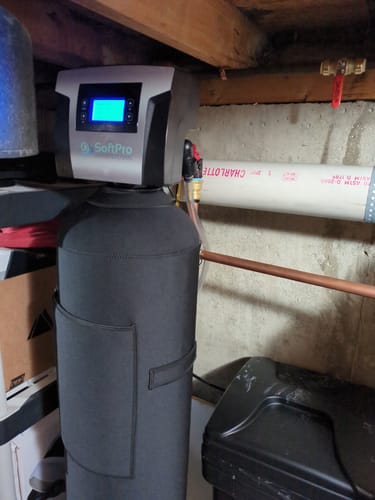
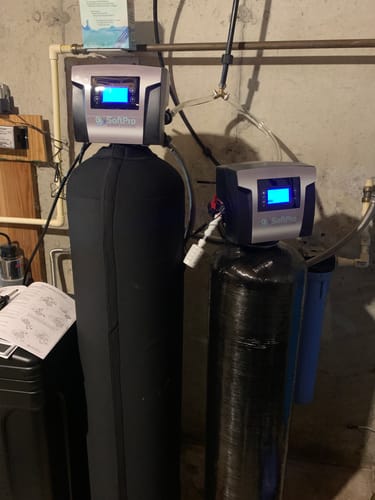
The system arrived in two large, well-packaged boxes - one for each tank. I was immediately impressed by the weight; these aren't flimsy plastic tanks but serious fiberglass construction. The main softening tank stands about 54 inches tall with a 10-inch diameter, while the brine tank is more compact but substantial.
The control valve is the brain of the operation - a digital Fleck 9100SXT that looked far more sophisticated than the basic mechanical timers I'd seen on cheaper units. The LCD display was clear and intuitive, showing current time, regeneration status, and gallons remaining until the next cycle.
All the necessary fittings were included: bypass valve, drain line fittings, and detailed installation hardware. The manual was comprehensive without being overwhelming - clearly written by people who understand that not everyone is a plumbing expert.
One detail that impressed me was the quality of the resin beads. SoftPro uses high-grade ion exchange resin with a longer lifespan than standard resin. You can actually see the golden-colored beads through the tank's inspection port - they looked uniform and clean, not like the mixed-grade resin you might find in budget systems.
Installation Experience: Easier Than Expected
 >
> I'll be honest - I considered hiring a plumber for this installation. The system requires cutting into your main water line, installing bypass valves, and connecting drain lines. But after watching several installation videos and reading the manual twice, I decided to tackle it myself.
The most challenging part was locating the ideal installation spot. You need access to the main water line, electrical outlet, drain, and enough space for both tanks. I chose a spot in our utility room that met all these requirements while keeping the system accessible for maintenance.
Cutting into the copper main line was nerve-wracking, but the bypass valve installation went smoothly with the provided fittings. The system uses standard 1-inch NPT connections, so no special adapters were needed. I appreciated that SoftPro includes a proper bypass valve - not the cheap ball valve assemblies that some manufacturers provide.
The drain line connection was straightforward. The system requires a drain for backwash water during regeneration. I connected it to our utility sink drain with a simple air gap to prevent backflow. The electrical connection is just a standard 110V plug - no hardwiring required.
Total installation time was about four hours, including a trip to the hardware store for additional fittings. A professional could probably do it in two hours, but I appreciated taking my time to understand how everything worked.
The initial startup sequence involves filling the tanks, setting the water hardness level, and running a manual regeneration cycle. The control valve walked me through each step clearly. I set our hardness at 12 grains per gallon based on my water test results.
Performance Testing: Measurable Improvements Across the Board
 >
> I'm a numbers guy, so I tested everything I could measure. Before installation, our water tested at 12 grains per gallon hardness and had a total dissolved solids (TDS) reading of 320 ppm. Twenty-four hours after installation, the hardness was 0 grains per gallon, and TDS dropped to 280 ppm.
The immediate difference was noticeable in daily tasks. Soap lathered better in the shower - I actually had to adjust how much shampoo I used because it was creating more suds than before. Dish soap became dramatically more effective; I could clean greasy pans with half the detergent I used previously.
Our coffee maker was the most dramatic improvement. The water heated faster and more evenly, and the coffee tasted noticeably better. I hadn't realized how much the mineral content was affecting the flavor until it was gone. The machine also stopped making those struggling sounds during brewing.
I monitored our salt consumption carefully during the first month. The system used approximately 40 pounds of salt per month for our family of four - exactly what SoftPro's calculations predicted. The high-efficiency design really does use less salt than traditional systems.
Water flow rate remained excellent throughout the house. I was concerned that adding the softener might reduce pressure, but I measured only a 2-3 PSI drop from municipal supply pressure. Even with multiple fixtures running simultaneously, we maintained strong water pressure.
The regeneration cycles occur automatically based on actual water usage, not a timer. This means the system only regenerates when needed, saving salt and water. I tracked regeneration frequency and found it occurred every 4-5 days initially, settling into a predictable pattern based on our usage.