/>
/>Look, I'm not the type to get excited about appliances, but when your water tastes like it came from a swimming pool and leaves your skin feeling like sandpaper, something's gotta give. That's exactly where Joe O. from Rhode Island found himself last year — staring at mineral buildup on every faucet and wondering why his "great" city water felt anything but great. After months of research and frankly getting tired of feeling like he was showering in chalk water, he pulled the trigger on the SoftPro® Elite HE Water Softener for City Water (Industry's Best Softener & Filter Combo). But did this thing actually live up to the hype, or was it just another expensive disappointment?
Here's exactly what happened after eight months of real-world testing.
The Water Problem That Started Everything
Let me paint you a picture of what "city water" actually meant in my neighborhood. Sure, it passed all the municipal tests and technically met safety standards, but living with it day-to-day was a different story entirely.
Every morning, I'd wake up to that distinctive chlorine smell wafting from the bathroom faucet. My coffee tasted off — not terrible, but definitely not the rich flavor I was paying premium prices for. The shower left my skin feeling tight and itchy, especially during winter months. My wife constantly complained about her hair feeling dry and brittle, despite using expensive conditioners.
But the real wake-up call came when I noticed the white, chalky buildup around every water fixture in the house. The showerheads were clogged with mineral deposits. The dishwasher left spots on everything, even with rinse aid. Our water heater seemed to be working harder and less efficiently than when we first moved in.
I started researching and learned that our city water, while safe to drink, contained significant levels of hardness minerals — primarily calcium and magnesium — along with chlorine for disinfection. The hardness was measuring around 12 grains per gallon, which puts it in the "moderately hard" to "hard" category. For context, anything over 7 grains per gallon is considered hard water that can cause the issues I was experiencing.
The chlorine levels, while within EPA guidelines, were high enough to affect taste and odor. Municipal water treatment facilities use chlorine because it's effective and cost-efficient for large-scale disinfection, but that doesn't mean it's pleasant for daily consumption or bathing.
I calculated the hidden costs of living with this water quality: frequent descaling of appliances, increased soap and detergent usage (hard water reduces soap efficiency), potential premature replacement of water heaters and other appliances, and the ongoing expense of bottled water because we'd basically stopped drinking from the tap.
Something had to change, and I needed a solution that would address both the hardness minerals and the chlorine taste and odor issues simultaneously.
Why I Chose the SoftPro Elite HE Over Other Options
 >
>The research phase took me down some serious rabbit holes. I spent weeks comparing different approaches: traditional salt-based water softeners, salt-free water conditioners, whole-house filters, and various combination systems.
Here's what I learned that influenced my decision: salt-free systems don't actually remove hardness minerals — they claim to change their structure to reduce scaling, but you still get the soap efficiency issues and the dry skin problems. Whole-house carbon filters address chlorine and taste issues but do nothing for hardness. Most combination systems require multiple tanks and complicated plumbing.
The SoftPro Elite HE caught my attention because it promised to solve both problems in a single, streamlined system. The "HE" stands for High Efficiency, which appealed to my practical side — less salt usage, less water waste during regeneration, and lower operating costs over time.
What really sold me was the SoftPro Valve technology. Unlike some competitors that use third-party control valves, SoftPro designs and manufactures their own valves specifically for their systems. This means better integration, more reliable performance, and no finger-pointing between different manufacturers if something goes wrong.
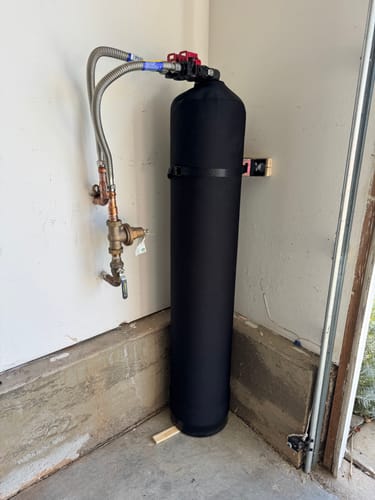
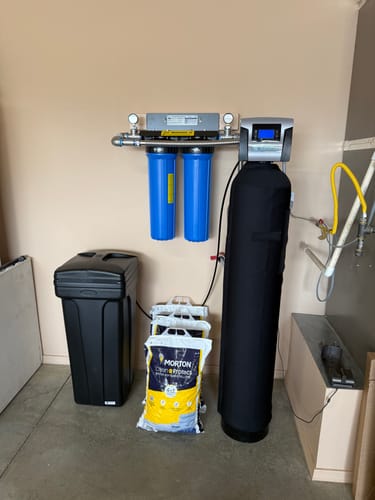
The system combines ion exchange resin for hardness removal with catalytic carbon media for chlorine, taste, and odor reduction. This dual-media approach in one tank eliminates the need for separate softener and filter systems, saving space and simplifying maintenance.
I also appreciated that SoftPro has been in the water treatment business for over 30 years and manufactures their systems in the USA. The warranty coverage was comprehensive — 10 years on the tank, 7 years on the SoftPro Valve, and 3 years on internal components.
The capacity was perfect for our household of three. The system can handle up to 64,000 grains of hardness removal between regenerations, which translates to about 10-14 days between cycles with our water usage and hardness levels.
Price-wise, it wasn't the cheapest option, but it wasn't the most expensive either. When I factored in the dual functionality and long-term efficiency, the cost per year of ownership actually looked quite reasonable compared to buying separate systems or dealing with the ongoing costs of untreated water.
Installation Experience and First Impressions
The SoftPro Elite HE arrived in packaging that immediately conveyed quality. Everything was well-protected and organized, with clear labeling for each component. The main tank has a solid, substantial feel — not flimsy or cheap-looking like some units I'd seen.
I went with professional installation, which I'd recommend unless you're very comfortable with plumbing modifications. The installer was familiar with SoftPro systems and had everything connected in about three hours. The process involved installing a bypass valve, connecting the inlet and outlet lines, setting up the drain line for regeneration cycles, and programming the SoftPro Valve controller.
One thing I appreciated was how compact the system is. Even though it's handling both softening and filtration, it takes up less space than I expected. The tank dimensions are about 10 inches in diameter and 54 inches tall, fitting easily in our utility room alongside the water heater.
The digital controller on the SoftPro Valve is intuitive and straightforward. It tracks water usage, displays days until the next regeneration, and allows you to adjust settings based on your household's specific needs. No complicated programming or confusing menu systems.
Initial startup was smooth. The installer walked me through the basic operations, showed me how to add salt to the brine tank, and explained the regeneration cycle timing. The system ran its first regeneration cycle that night — I could hear it working, but it wasn't disruptive or particularly loud.
The first thing I noticed the next morning was the complete absence of chlorine smell from the tap water. The taste was clean and neutral — finally, water that actually tasted like water instead of a mild chemical solution.
Performance Testing: The Numbers That Matter
 >
> I'm the type of person who likes to measure things, so I invested in a basic water testing kit to track the system's performance objectively. Here's what the data showed over the first several months.
Hardness removal has been consistently excellent. Our incoming water tests at 12 grains per gallon, and post-softener water consistently measures 0-1 grains per gallon. That's essentially complete removal of hardness minerals, which translates to immediate practical benefits.
Chlorine reduction is equally impressive. Using test strips designed for pool and spa testing (which work fine for measuring chlorine in drinking water), I found that incoming water showed 2.5-3.0 ppm of chlorine, while treated water showed no detectable chlorine.
The most noticeable change was in soap and detergent efficiency. I was able to reduce laundry detergent usage by about 40% while getting better cleaning results. Dish soap lathers better and rinses cleaner. Shampoo works more effectively, requiring less product for the same results.
Water pressure remained excellent throughout the system. I was concerned that adding filtration might create pressure drops, but flow rates are virtually identical to pre-installation levels. The system is rated for 12 GPM flow rate, which easily handles multiple simultaneous uses like shower and dishwasher operation.
Regeneration cycles occur approximately every 12 days with our usage patterns. Each cycle uses about 40 pounds of salt and runs for roughly 90 minutes, typically during off-peak hours when we're not using water. The system automatically calculates when regeneration is needed based on actual water usage rather than just running on a timer.
I tracked salt consumption over six months and found we're using about 100 pounds every two months. At local salt prices, that works out to roughly $15-20 monthly for salt, which is reasonable considering the benefits.
Daily Life Impact: The Real-World Benefits
 >
> The technical performance is one thing, but what really matters is how this system changed our daily experience with water throughout the house.
Morning routines became noticeably more pleasant. Showers feel softer and more refreshing. My wife immediately noticed that her hair felt silkier and https://www.trustpilot.com/review/softprowatersystems.com required less conditioner. My skin stopped feeling tight and itchy after bathing, especially during dry winter months when the difference was most pronounced.
Coffee and tea taste significantly better. The chlorine taste that used to affect hot beverages is completely gone, and there's no off-flavor from minerals. We stopped buying bottled water for drinking and cooking, which saves money and reduces plastic waste.
Cleaning became easier and more effective. Soap scum formation in the shower dropped dramatically. Dishes come out of the dishwasher spot-free without rinse aid. Laundry feels softer and brighter, and white fabrics stay white longer.
Appliance performance improved noticeably. The water heater seems to heat water faster and maintain temperature more consistently. The dishwasher runs more quietly and cleans more effectively. Even small appliances like the coffee maker and humidifiers stay cleaner with less frequent descaling needed.
We had guests over several months after installation, and multiple people commented on how good the water tasted and how soft it felt. When you're used to treated water, going back to hard, chlorinated water at other locations becomes immediately noticeable.
One unexpected benefit was reduced skin irritation for our family members who have sensitive skin. The combination of removing hardness minerals and chlorine created water that's much gentler for bathing and reduces the drying effects that can aggravate skin conditions.
Seasonal changes haven't affected system performance. During summer months when municipal chlorine levels tend to be higher, the system continues to provide consistent taste and odor removal. Winter months when skin tends to be drier anyway, the soft water helps maintain more comfortable skin moisture.