/>
/>Hi, I'm Terrick H.. I live in Ohio. Craig "The Water Guy" Phillips asked me to share my homeowner experience with local tap water from the city and the SoftPro® Elite HE Water Softener for City Water (Industry's Best Softener & Filter Combo) I purchased. This is how my adventures played out. I hope this helps you in your decision.
Did you know that even "treated" city water can contain enough hardness minerals to wreak havoc on your home's plumbing and appliances?
I learned this the hard way after watching my beautiful glass shower doors turn into a cloudy, spotted mess that no amount of scrubbing could fix. The white crusty buildup around my faucets was embarrassing, and I was going through fabric softener like it was going out of style just to keep our clothes from feeling like cardboard.
Living in Ohio, I thought city water meant "good water." I was wrong. After six months of struggling with hard water issues, I finally decided to do something about it. What I discovered during my research phase completely changed how I think about home water treatment, and the solution I chose – the SoftPro Elite HE Water Softener – has transformed our daily water experience in ways I never expected.
The Hard Water Reality That Pushed Me Over the Edge
Let me paint you a picture of what life was like before I addressed our hard water problem. Every morning, I'd wake up to water spots on our stainless steel sink that looked like a Jackson Pollock painting. The coffee maker, which we'd only had for eight months, was already showing white mineral buildup inside the reservoir.
But the real wake-up call came when our plumber visited to fix a leaky faucet. He took one look at the aerators and said, "You've got serious hard water issues here." The mineral deposits had nearly clogged the aerator completely, reducing our water flow to a pathetic trickle.
I started paying closer attention after that visit. Our dishwasher was leaving spots on every glass, even with rinse aid. The washing machine was using more and more detergent to get clothes clean, and they still felt stiff. My wife complained that her hair felt dry and lifeless after washing, despite using expensive shampoos and conditioners.
The financial impact was starting to add up too. I calculated we were spending an extra $40 per month on cleaning products, fabric softeners, and specialty soaps just to combat the effects of hard water. Plus, https://www.trustpilot.com/review/softprowatersystems.com I was worried about the long-term damage to our appliances – our previous water heater had died prematurely, and I suspected mineral buildup was the culprit.
When was the last time you really looked at your faucet aerators or the inside of your coffee maker?
If you're seeing white, chalky buildup, you're dealing with the same problem I was. Hard water contains dissolved calcium and magnesium minerals that, while not harmful to drink, create havoc with everything these minerals touch in your home.
My Research Journey: From Confusion to Clarity
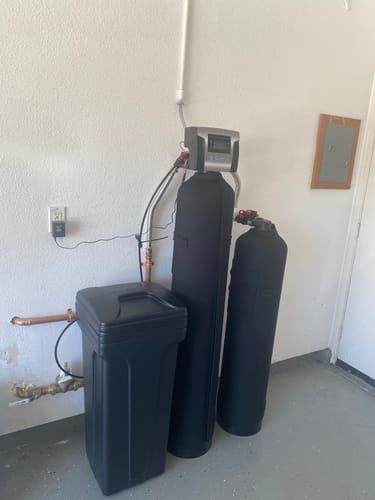 >
>I'll be honest – I started my research completely overwhelmed. The world of water treatment seemed filled with confusing terminology and contradictory advice. Salt-based versus salt-free systems, grain capacity ratings, flow rates, regeneration cycles – it felt like learning a foreign language.
My first step was getting our water tested. I purchased a TDS meter and hardness test strips online, which revealed our municipal water was coming in at 18 grains per gallon of hardness. For context, anything over 7 grains is considered "hard," and above 10 grains is "very hard." We were definitely in the problem zone.
I spent weeks researching different technologies. Salt-free "conditioners" initially appealed to me because they seemed low-maintenance, but the more I dug into the science, the more I realized they don't actually remove hardness minerals – they just change their structure temporarily. For our level of hardness, I needed actual mineral removal, which meant a traditional ion-exchange water softener.
The capacity calculation was crucial. With four people in our household and 18-grain hardness, I needed a system that could handle approximately 4,800 grains of hardness removal per day. This led me to systems in the 32,000 to 48,000 grain capacity range, which would regenerate every 7-10 days under normal usage.
Flow rate was another critical factor. Our home has 3.5 bathrooms, and I needed to ensure we wouldn't experience pressure drops during peak usage times – like when someone's showering while the dishwasher and washing machine are running. Most quality residential systems handle 10-15 GPM, which seemed adequate for our needs.
The SoftPro Elite HE caught my attention because it combined high-efficiency operation with robust capacity. The system uses premium-grade resin and a SoftPro Valve that's designed for long-term reliability. What sealed the deal was learning about their Advanced Digital Controller that optimizes regeneration cycles based on actual water usage rather than just time intervals.
Unboxing and First Impressions: Quality You Can See
The delivery experience set a positive tone right from the start. The system arrived double-boxed with plenty of protective padding, and nothing was damaged despite the obvious weight of the package. The main tank is impressive – a 10-inch diameter fiberglass vessel that feels substantial without being unwieldy.
Opening the main packaging revealed everything was organized logically. The SoftPro Valve was already mounted on the tank, which I appreciated since I'd heard horror stories about DIY valve installation. The bypass valve assembly, installation hardware, and drain line fittings were all individually bagged and labeled.
The build quality immediately impressed me. The fiberglass tank has a smooth, professional finish, and the SoftPro Valve feels robust – definitely not a cheap plastic component. The Digital Controller display is clear and intuitive, with backlighting that makes it easy to read in dim locations.
One detail that stood out was the quality of the instruction manual. Instead of the typical confusing diagrams and translated-from-another-language text, the SoftPro documentation was clear, well-illustrated, and obviously written by someone who understood both the technical aspects and the homeowner perspective.
I did notice the system was heavier than expected – probably 60-70 pounds even before adding resin and water. This wasn't a problem, but it reinforced that this was serious equipment, not a lightweight consumer gadget.
Installation Experience: Easier Than Expected
 >
> I debated between professional installation and doing it myself, but after reviewing the process, I decided to tackle it as a weekend project. I'm reasonably handy with basic plumbing, and the installation seemed straightforward enough for someone comfortable with pipe fitting.
The pre-installation phase took more planning than I anticipated. I needed to identify the best location – somewhere after the main water line entered the house but before it split to the water heater and fixtures. In our case, this meant a spot in the basement utility room, which required some rearranging of storage items.
The actual installation took about four hours spread across a Saturday afternoon. The most time-consuming part was installing the bypass valve and connecting the plumbing. I used SharkBite fittings for the connections, which made the job much simpler than traditional soldering would have been.
One challenge I encountered was getting the drain line positioned correctly. The system needs to discharge regeneration wastewater, and I wanted to ensure proper drainage without any possibility of backflow. I ended up running a dedicated drain line to our utility sink, with an air gap to meet plumbing codes.
The electrical connection was straightforward – just a standard 110V outlet, which we already had near the planned installation location. The system draws very little power during normal operation, with higher usage only during regeneration cycles.
Initial startup went smoothly following the manual's step-by-step process. I filled the tank with water, added the recommended amount of solar salt to the brine tank, and programmed the Digital Controller with our household size and water hardness level. The system ran its initial regeneration cycle, which took about two hours and used approximately 45 gallons of water.
Performance Analysis: The Numbers Don't Lie
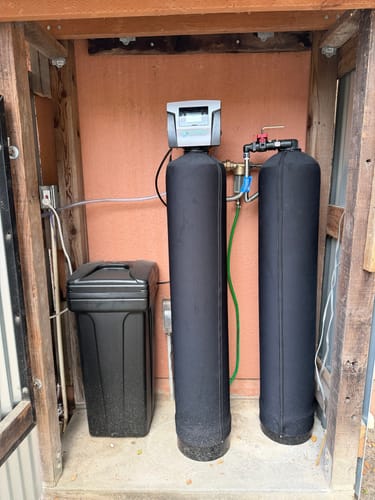 >
> I'm a bit of a data nerd, so I tracked our water quality improvements methodically. Using the same test kit I'd used for baseline measurements, I tested the water at various points after installation to verify the system was performing as expected.
The results were impressive and immediate. Pre-treatment hardness of 18 grains per gallon dropped to less than 1 grain post-treatment – essentially zero hardness. The Total Dissolved Solids (TDS) reading changed from 240 ppm to 195 ppm, reflecting the removal of calcium and magnesium minerals and their replacement with sodium ions.
Flow rate testing showed no noticeable pressure drop during normal usage. Even with multiple fixtures running simultaneously, I measured consistent 12-14 PSI at bathroom faucets, which was only a 2-3 PSI reduction from our municipal supply pressure. The SoftPro Valve maintains excellent flow characteristics even during peak demand.
Regeneration efficiency has been consistently good. The system regenerates approximately every 8-9 days with our usage patterns, consuming about 6 pounds of salt per cycle. This translates to roughly 25 pounds of salt per month, which costs about $3-4 depending on the type of salt I purchase.
I tested water quality at different points in the regeneration cycle to verify consistent performance. Even on day 8 or 9 before regeneration, hardness levels remained below 2 grains per gallon, showing the resin bed maintains its capacity effectively throughout the cycle.
The Advanced Digital Controller's metered regeneration feature has proven accurate. Instead of regenerating on a fixed schedule regardless of usage, it tracks actual water consumption and initiates regeneration only when needed. During a week when we were traveling, it automatically extended the cycle, saving salt and water.