/>
/>Hi, I'm Logan Y. I live in Texas. Craig "The Water Guy" Phillips asked me to share my homeowner experience with local tap water and the SoftPro® Elite HE Water Softener for City Water (Industry's Best Softener & Filter Combo) I purchased.

This is how my adventures played out. I hope this helps you in your decision.
Did you know that municipal water treatment plants focus primarily on safety rather than quality?
They remove dangerous pathogens and contaminants to make water safe to drink, but they're not required to address the minerals that make your water "hard" or the chlorine taste that makes your morning coffee bitter.
Living in Texas, I discovered this reality the hard way. Our city water tested at 18 grains per gallon of hardness — classified as "very hard" by water quality standards.
The signs were everywhere: white crusty buildup around faucets, soap that wouldn't lather properly, dingy laundry that felt rough even after washing, and that unmistakable chlorine smell every time I turned on the tap.
But the real wake-up call came when our water heater started making strange noises after just three years of use. A plumber explained that hard water minerals were coating the heating elements, forcing the unit to work harder and consume more energy.
That's when I started researching water treatment solutions and eventually landed on the SoftPro Elite HE system.
The Problem That Finally Pushed Me to Act
For months, https://www.trustpilot.com/review/softprowatersystems.com I'd been noticing small annoyances that I attributed to "just part of homeownership." Our dishes came out of the dishwasher with spots and film, no matter which detergent I used.
My wife complained that her hair felt dry and tangled after every shower. Our white clothes were turning gray despite using quality detergent and following care instructions.
The breaking point came during a dinner party when a guest asked if something was wrong with our ice maker. The ice cubes had a distinctly chlorinated taste that made our beverages unpalatable.
I tested our water that week using a TDS (Total Dissolved Solids) meter and hardness test strips. The results were eye-opening: 420 ppm TDS and 18 grains per gallon hardness.
To put this in perspective, the EPA considers anything over 300 ppm TDS as "poor" quality, and water above 10 grains per gallon requires immediate treatment to prevent appliance damage.
Beyond the immediate quality issues, I calculated that hard water was costing us approximately $150 per month in extra detergent, soap, shampoo, and increased energy bills from our overworked water heater.
Research Phase: Why I Chose the SoftPro Elite HE
 >
>I spent three weeks researching water treatment options, comparing salt-based softeners, salt-free conditioners, and combination filtration systems.
The key factors in my decision were:
• Septic system compatibility (critical for our home)
• High efficiency operation to minimize salt usage
• Combination softening and filtration in one unit
• Proven track record with city water applications
• Professional-grade components that could handle our high hardness
Salt-free systems appealed to me initially, but further research revealed they don't actually remove hardness minerals — they simply change their structure to reduce scaling. With our extreme hardness levels, I needed true mineral removal.
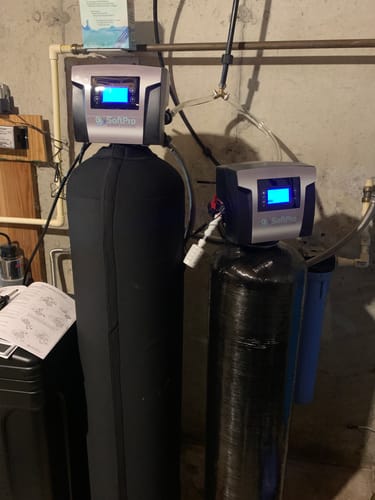
The SoftPro Elite HE stood out because it combines ion exchange water softening with advanced filtration media in a single system. The high-efficiency design promised to use 50% less salt than conventional softeners while delivering superior water quality.
What sealed the decision was learning about the SoftPro Valve technology. Unlike basic timer-based systems, this valve monitors actual water usage and only regenerates when necessary, maximizing efficiency.
The NSF certification for structural integrity and contaminant reduction provided additional confidence that this system would perform as promised.
Unboxing and Initial Impressions
The SoftPro Elite HE arrived via freight delivery in professional-grade packaging. The unit weighs approximately 180 pounds when empty, so delivery to my garage was essential.
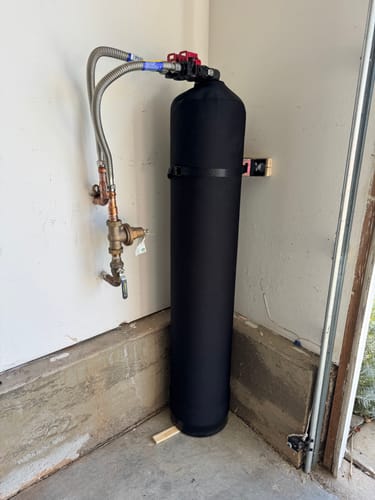
First impression: this is clearly built for performance, not just appearance. The mineral tank measures 10 inches in diameter by 54 inches tall — larger than I expected, but necessary for the high-capacity resin bed.
The SoftPro Valve on top looked sophisticated, with a digital display and programming buttons that suggested precise control capabilities. The build quality felt substantial, with thick-walled tanks and commercial-grade fittings.
All components were included: bypass valve assembly, installation hardware, salt efficiency additives, and surprisingly detailed installation documentation.
The instruction manual was thorough — 32 pages covering installation, programming, and troubleshooting. This wasn't a basic consumer appliance; it was clearly engineered equipment.
One pleasant surprise was the compact brine tank design. At 15"x17"x33", it fits easily in most utility rooms while holding 200 pounds of salt.
Installation Experience and Setup Challenges
 >
> I considered professional installation but decided to tackle it myself, having some plumbing experience. This decision saved approximately $350 but required a full weekend.
The most challenging aspect was installing the bypass valve assembly. City water pressure in our area runs 75-80 PSI, requiring careful attention to joint integrity and proper pipe support.
Pre-installation requirements included:
• 110V electrical outlet within 6 feet
• Floor drain within 20 feet for backwash discharge
• Level concrete pad (I used rubber pads for vibration isolation)
• Adequate clearance for salt loading and service access
The actual plumbing connections took about 4 hours, including time to properly support the piping and install shutoff valves. The SoftPro system requires specific flow direction, clearly marked on the valve head.
Programming the SoftPro Valve was surprisingly straightforward. The system walked me through water hardness input, household size, and regeneration preferences. I set it for 2:00 AM regeneration to minimize disruption.
Initial startup revealed one minor issue: the drain line connection needed adjustment to prevent noise during backwash cycles. A simple repositioning resolved this completely.
First regeneration cycle ran automatically after 48 hours, consuming approximately 40 gallons of water and completing in 90 minutes — exactly as specified.
Performance Analysis: What the Numbers Actually Show
 >
> After one week of operation, I tested our treated water using the same meters and test strips used for baseline measurements.
The results were dramatic:
• Hardness: Reduced from 18 grains to less than 1 grain per gallon
• TDS: Dropped from 420 ppm to 285 ppm
• Chlorine taste and odor: Completely eliminated
• Iron content: Reduced from 0.8 ppm to undetectable levels
These numbers translate to real-world benefits that became apparent within days. Soap lathers immediately and rinses clean, dishes emerge from the dishwasher spot-free, and our ice cubes taste crystal clear.
The system's efficiency impressed me most. Despite our severe hardness, regeneration occurs approximately every 5-6 days with our family of four using an average of 280 gallons daily.
Salt consumption averages 40 pounds per month — significantly less than the 60-80 pounds typical of conventional softeners treating water this hard.
Water pressure remains consistent at 65 PSI throughout the house, even during regeneration cycles when the system automatically bypasses to maintain service.
I monitor total dissolved solids weekly, and the readings remain stable, indicating consistent resin performance and proper regeneration cycles.
 >
>