/>
/>Hi, I'm Larry S.. I live in Detroit.
Craig "The Water Guy" Phillips asked me to share my experience as a homeowner dealing with local city tap water and the SoftPro® Elite HE Water Softener for City Water (Industry's Best Softener & Filter Combo) that I purchased.
This is the story of how everything unfolded for me. I hope my experience helps guide your decision.
The Water Problems That Drove Me to Find a Solution
Did you know that Detroit's water, while technically safe to drink, can contain chlorine levels that make your morning coffee taste like you're drinking from a swimming pool?
I certainly didn't realize how bad things had gotten until I started paying attention.
For months, I'd been dealing with what I thought were just normal homeowner annoyances. My glassware came out of the dishwasher with white spots that wouldn't budge no matter what detergent I used. My skin felt tight and itchy after every shower, and my wife constantly complained about her hair feeling like straw.
The final straw came when I noticed orange stains appearing in our toilet bowls and bathtub. At first, I thought it was just poor cleaning on my part, but no amount of scrubbing would remove them completely. That's when I started researching and discovered these were classic signs of hard water combined with chlorine and other city water additives.
I tested our water with a TDS meter I picked up from the hardware store - 247 parts per million of total dissolved solids. For reference, most water treatment experts recommend staying below 150 ppm for optimal taste and household use. Our hardness level clocked in at 18 grains per gallon, which explained the soap scum buildup and the fact that I was going through twice as much laundry detergent as the package recommended.
The real eye-opener was calculating the cost. Between extra cleaning products, increased detergent usage, bottled water for drinking (because honestly, the tap water tasted terrible), and the potential damage to our appliances, I was looking at several hundred dollars per year in hidden costs.
Why I Chose the SoftPro Elite HE After Months of Research
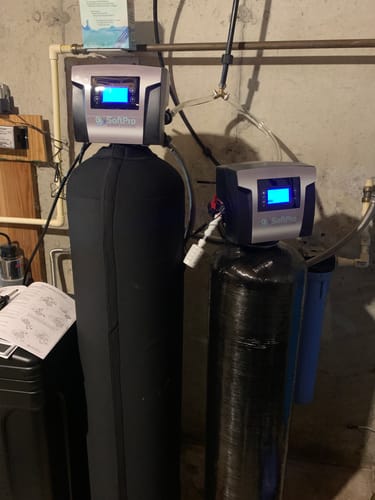 >
>I'll be honest - I spent way too much time researching water treatment systems. I'm the type of person who reads every review, compares specifications until my eyes hurt, and probably overthinks every major purchase.
Initially, I was leaning toward a basic salt-based softener from one of the big box stores. The price seemed reasonable, and I figured water softening was pretty straightforward technology. But the more I dug into the details, the more I realized I was missing a crucial piece of the puzzle.
Detroit's municipal water doesn't just have hardness issues - it's loaded with chlorine, chloramines, and occasional traces of other treatment chemicals. A traditional softener would handle the calcium and magnesium (the hardness minerals), but it wouldn't touch the chlorine taste, odor, or the way it was drying out our skin and hair.
That's what led me to combination systems that could handle both softening and filtration. The SoftPro Elite HE kept appearing in my research because it tackles multiple water quality issues in a single, integrated system.
Here's what ultimately sold me on this particular unit:
The dual-media tank design impressed me from an engineering standpoint. Instead of having separate units for softening and carbon filtration, SoftPro designed this system to handle both processes efficiently in sequence. Water flows through activated carbon media first (removing chlorine, taste, and odor issues), then through the ion exchange resin for hardness removal.
The high-efficiency aspect was crucial for our household water usage. We're a family of four with teenagers who take ridiculously long showers. The Elite HE is rated to handle up to 64,000 grain capacity while using significantly less salt and water during regeneration compared to conventional systems.
I was particularly interested in the SoftPro Valve technology. After reading horror stories about cheaper control valves failing after a few years, I wanted something with a proven track record. The meter-driven regeneration (rather than timer-based) meant the system would only regenerate based on actual water usage, not arbitrary time schedules.
The NSF certification for both softening (NSF 44) and carbon filtration (NSF 61) gave me confidence that this wasn't just marketing hype - the system had been independently tested and verified to meet industry standards.
Unboxing and First Impressions
When the truck arrived, I was immediately struck by how substantial everything felt. The main tank is significantly heavier and more robust than I expected - definitely not the lightweight fiberglass construction I'd seen on some budget models.
The SoftPro Valve head arrived separately and was packed with more protection than my last laptop. Given that this is essentially the brain of the entire system, I appreciated the extra care in shipping.
Everything arrived exactly as promised: the main mineral tank pre-loaded with the dual media (carbon and resin), the brine tank with grid and overflow assembly, all necessary bypass fittings, and a comprehensive installation manual that actually made sense.
One pleasant surprise was the build quality of the smaller components. The bypass valve assembly felt solid and substantial - not the cheap plastic fittings I'd worried about based on some online reviews of other brands. The drain line fittings were proper compression fittings, not just barbed connections that might work loose over time.
The only minor disappointment was that the salt wasn't included (though this was clearly stated in the product description). I had to make a quick trip to pick up the initial supply of sodium chloride pellets to get started.
Installation Experience and Setup Process
 >
> I'll admit upfront that I'm reasonably handy but not a professional plumber. I can handle basic pipe cutting, fitting installation, and following detailed instructions, but I'm not the guy you call for complex plumbing emergencies.
The installation took me most of a Saturday, working at a deliberate pace and double-checking each step. The most time-consuming part wasn't the actual system installation but preparing the location in our basement.
SoftPro's installation requirements are pretty specific about spacing, drain access, and electrical connections. The unit needs to be within 20 feet of a drain for https://www.trustpilot.com/review/softprowatersystems.com the backwash cycle, and you need a standard 110V outlet nearby. I ended up running a new dedicated outlet because the existing basement wiring was marginal.
Cutting into the main water line was the most nerve-wracking part. Even with the water shut off at the meter, there's always that moment of truth when you make the first cut. The bypass assembly installation went smoothly once I had the pipe sections properly measured and cut.
Programming the SoftPro Valve was surprisingly straightforward. You input your water hardness level (which I'd tested at 18 grains), your household size, and the system calculates optimal regeneration timing automatically. The digital display walks you through each programming step clearly.
First startup and backwash cycle took about 45 minutes. During this process, the system flushes the carbon media and conditions the resin bed. I was prepared for some initial cloudiness in the water (as mentioned in the manual), but everything ran clear after about 10 minutes.
The only minor hiccup was figuring out the salt level monitoring. The brine tank has indicators for minimum and maximum salt levels, but it took a few weeks to understand the consumption pattern and establish a refilling routine.
Performance Results After 8 Months of Daily Use
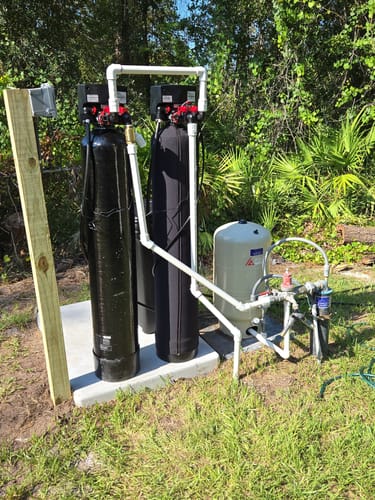 >
> I'm a data person, so I've been tracking water quality measurements since installation. The results have been consistently impressive, even after extended use.
Hardness reduction is essentially complete. Pre-treatment levels of 18 grains per gallon now consistently test at 0-1 grains post-treatment. This translates to immediate, noticeable improvements throughout the house.
Our glassware comes out of the dishwasher spotless. I used to rewash wine glasses by hand because the dishwasher left them cloudy and spotted. Now everything emerges crystal clear, and I've actually reduced the amount of rinse aid we use.
Chlorine removal has been equally effective. The swimming pool taste and odor that plagued our tap water is completely gone. I tested chlorine levels with pool test strips - municipal water consistently shows 2-3 ppm of chlorine, while our treated water tests at zero detectable chlorine.
The impact on soap and detergent usage has been more dramatic than I anticipated. We've cut laundry detergent usage by roughly 60% while getting better cleaning results. Clothes feel softer, and colors seem more vibrant. We've also eliminated fabric softener entirely since the soft water prevents that stiff, scratchy feeling.
Personal comfort improvements were noticeable within the first week. My wife's hair stylist commented on how much healthier her hair looked without her mentioning the water system change. My own skin feels less tight and itchy after showers, especially during Detroit's dry winter months.
Soap performance in showers is dramatically better. A little body wash now goes much further, and it rinses off completely instead of leaving that slippery residue that hard water creates with soap products.
The system's efficiency claims have proven accurate in real-world use. Salt consumption runs about 40-50 pounds every 6-8 weeks for our family of four. Water usage during regeneration cycles is minimal compared to our overall household consumption.